-THE SCIENCE OF ZERO CONTAMINATION-
THE WELD IS
ONLY THE
BEGINNING.
Most engineers know contamination happens during the weld. What they don't know is that titanium keeps oxidizing as it cools — and that invisible moment is where silent failures begin.
The insight that changes everything
"You have to let the parts cool in the argon atmosphere. The weld isn't over when the arc stops. It's over when the metal drops below its reactive temperature — inside a verified zero-oxygen environment." — Rick Montoya
The titanium oxidation colour scale — what every weld is telling you
Zero ppm
~50 ppm
~150 ppm
~350 ppm
~600 ppm
>1000 ppm
Every colour on this scale is a measurement. Silver means zero oxygen. Every other colour means the part has already failed — the question is only how badly.

-WHY REACTIVE METALS DEMAND A DIFFERENT ENVIRONMENT-
REACTIVE METALS
DEMAND A
DIFFERENT
ENVIRONMENT.
ENTIRELY.
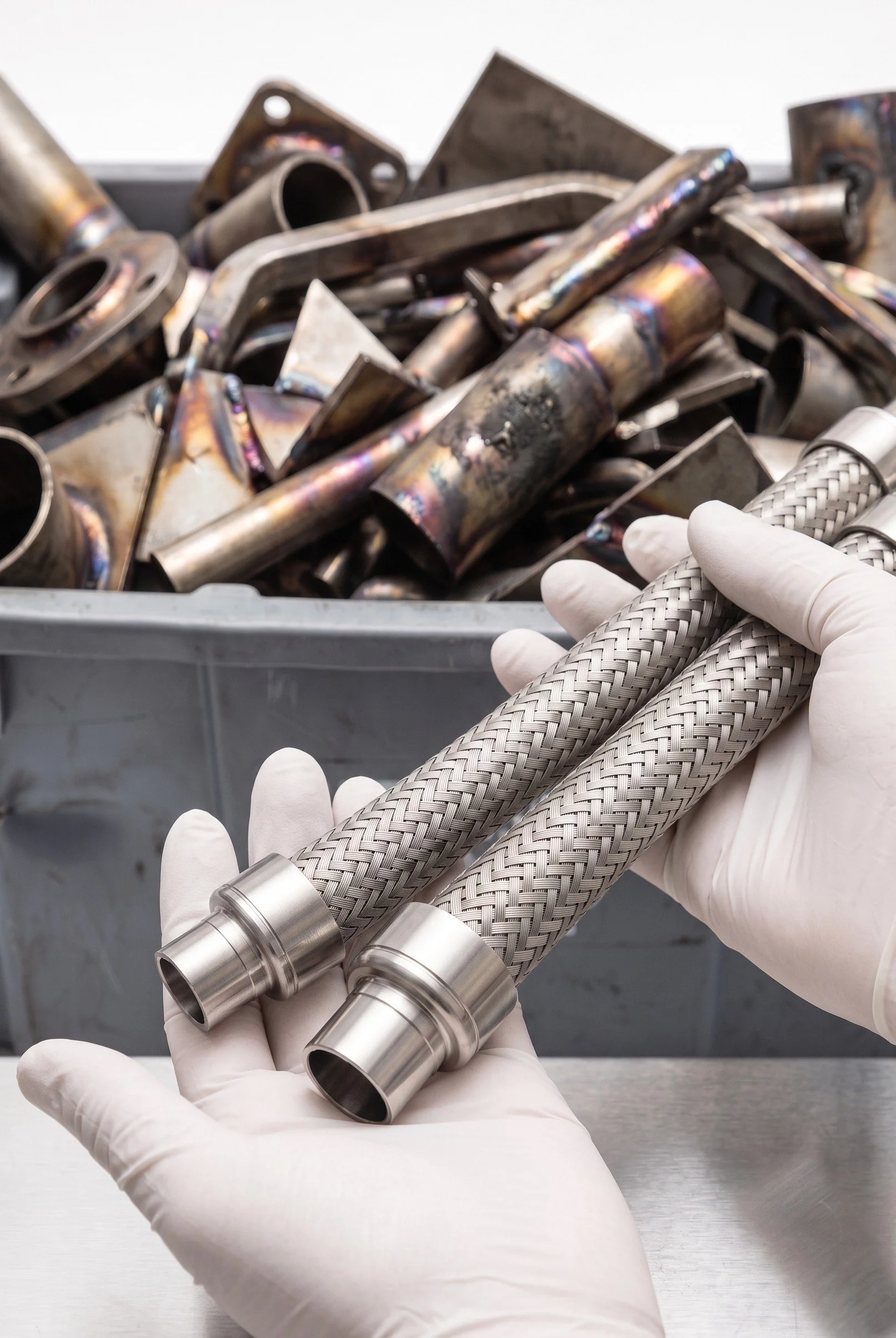
Reactive metals — titanium, Inconel, columbium, zirconium, and their alloys — are extraordinarily sensitive to atmospheric contamination during the welding thermal cycle. At welding temperatures, they react aggressively with oxygen and nitrogen in the surrounding atmosphere, absorbing these elements interstitially into their grain structure in a process that cannot be reversed, undone, or repaired. The damage is invisible to the eye and undetectable without NDT — but it is always there if the environment was not controlled.
Titanium gives us the most visceral evidence of this contamination — the oxidation colour scale makes the damage literally visible on the surface of the metal. But the physics are the same across every reactive alloy. Total immersion GTAW is not a titanium-specific requirement. It is the standard that every reactive metal demands — and the standard that the TRON E-Series delivers.
Failure Mode 01
Hydrogen embrittlement — the strength killer
When titanium absorbs hydrogen during welding or cooling, it forms titanium hydrides at grain boundaries — microscopic precipitates that make the metal brittle. A component that passes visual inspection and even dimensional verification may fail under load at a fraction of its designed strength. In propulsion hardware and human-rated structures, this failure mode is catastrophic.
Failure Mode 02
Cold cracking — the silent failure
Cold cracks form after the weld has solidified and cooled — sometimes hours or days later — as residual stress and hydrogen diffusion combine to initiate fractures that a post-weld inspection immediately after fabrication will not catch. This is why NDT on flight hardware is performed after a defined hold period, and why the welding atmosphere during cool-down is as critical as during the arc.
Failure Mode 03
Interstitial contamination — the porosity source
Oxygen and nitrogen absorbed into the titanium melt pool during welding create porosity, inclusions, and reduced ductility. These defects cause failed Radiographic Testing — but by the time they are detected, the component has already been built, and rework on flight hardware is rarely a viable option. Prevention at the source is the only effective strategy.
Reactive metal temperature threshold
800°F+
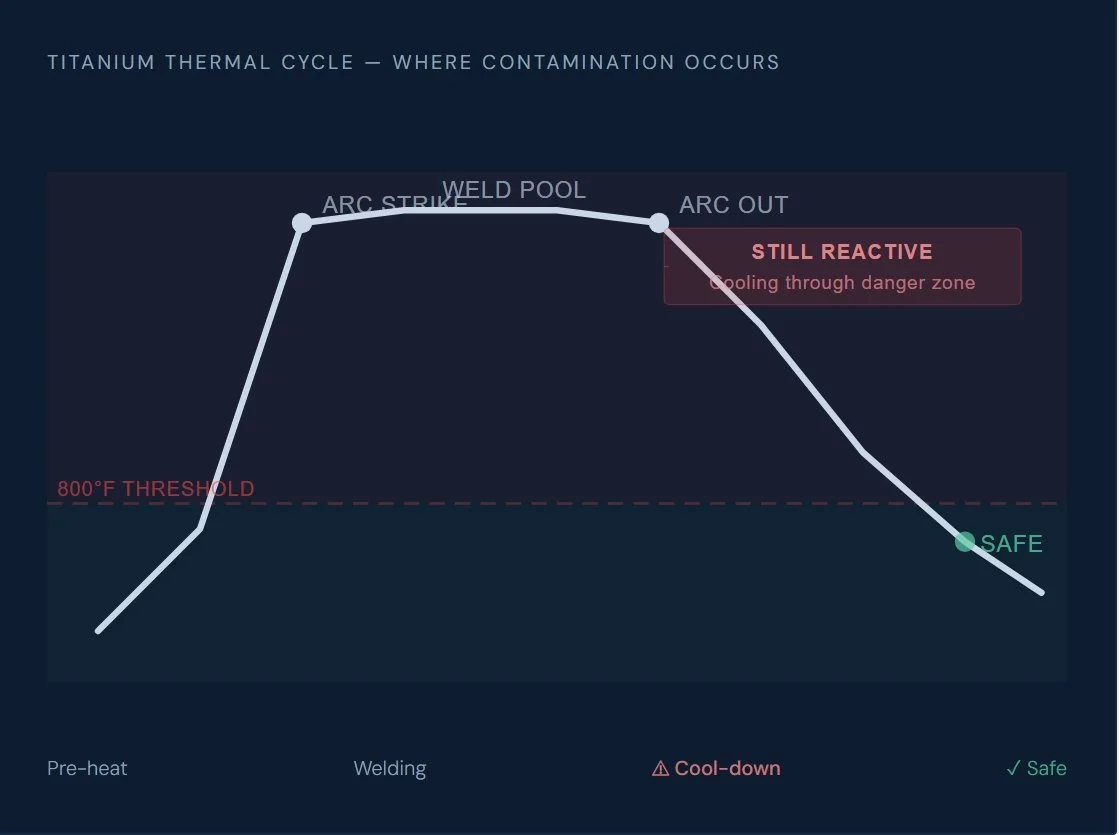
Above approximately 800°F (427°C), titanium, Inconel, columbium, zirconium, and reactive alloys begin reacting aggressively with atmospheric oxygen and nitrogen. Welding temperatures reach 3,000°F+. Every reactive metal remains contamination-sensitive throughout its cooling cycle — which is precisely why the argon atmosphere must be maintained until the part drops below its reactive threshold.
-THE TITANIUM OXIDATION COLOR SCALE-
COLOR IS
DATA.
SILVER IS THE
ONLY ANSWER.
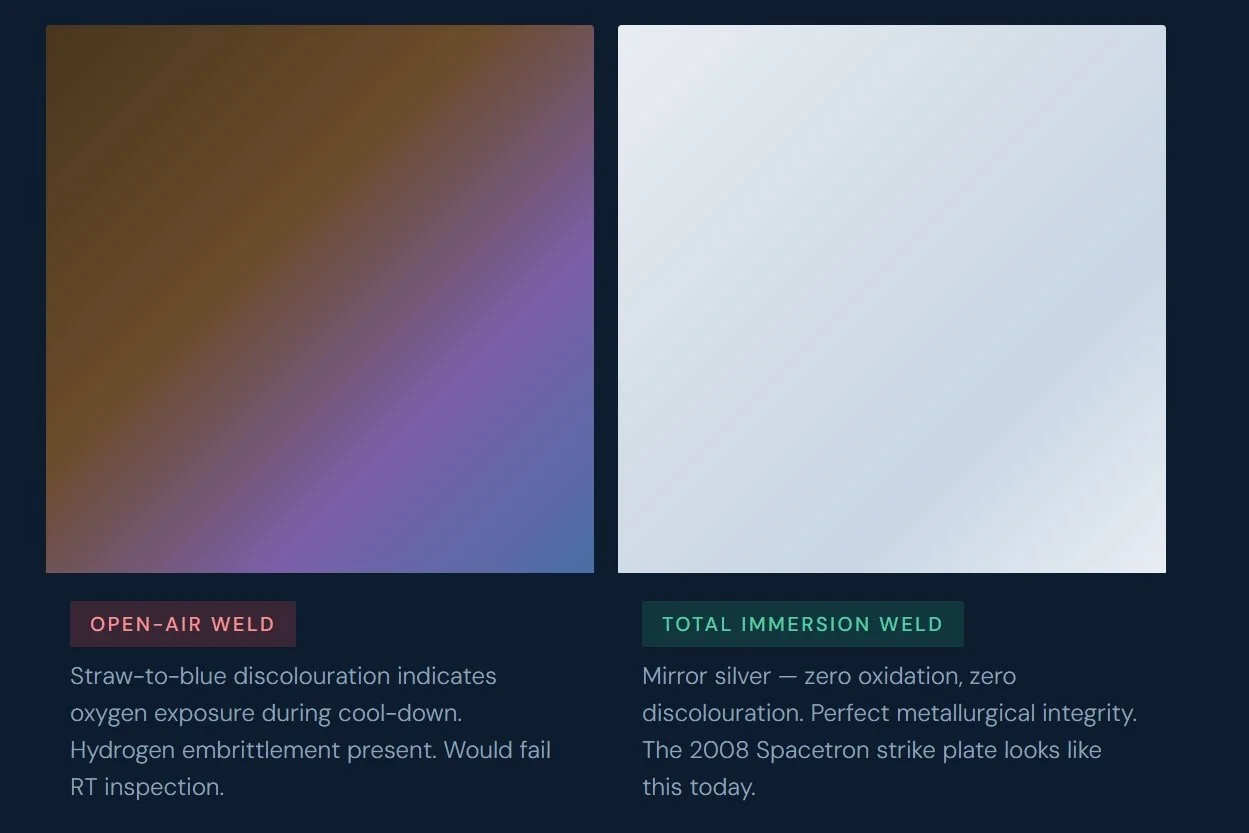
When titanium oxidizes during welding, the oxide layer that forms on its surface produces interference colours — the same optical phenomenon that makes soap bubbles iridescent. These colours are not cosmetic. Each one corresponds to a specific oxide thickness, which directly indicates the oxygen concentration the metal was exposed to during fabrication. They are a precise, visible measurement of contamination.
An inspector who knows this scale can look at a weld and know immediately whether the part is flight-worthy or scrap. For Spacetron, the only acceptable color is the first one.
The critical insight
Every colour on this scale — from straw to grey — represents oxygen that entered the titanium while it was above its reactive temperature. The weld may have been perfect. The shielding gas may have been flowing. But if the part was exposed to air at any point during its cooling cycle, the colour tells the truth. The only weld environment that guarantees silver is one where the atmosphere around the part is controlled from arc strike to cool-down — which is exactly what total immersion provides.
-THE INSIGHT MOST ENGINEERS HAVE NEVER PROCESSED-
THE ARC STOPS.
THE RISK
DOESN'T.
Rick Montoya's key teaching
Let the parts cool in the argon atmosphere.
When the arc stops, most welders assume the critical phase is over. It isn't. Titanium remains reactive from its welding temperature of 3,000°F all the way down through 800°F — a cooling journey that takes time, and during which every moment of atmospheric exposure causes irreversible contamination. The cool-down is not a passive waiting period. It is an active phase of the fabrication process that demands the same atmospheric control as the weld itself.
— PHYSICAL PROOF - NOT THEORY -
A 2008
TITANIUM WELD.
STILL PERFECTLY
SILVER TODAY.
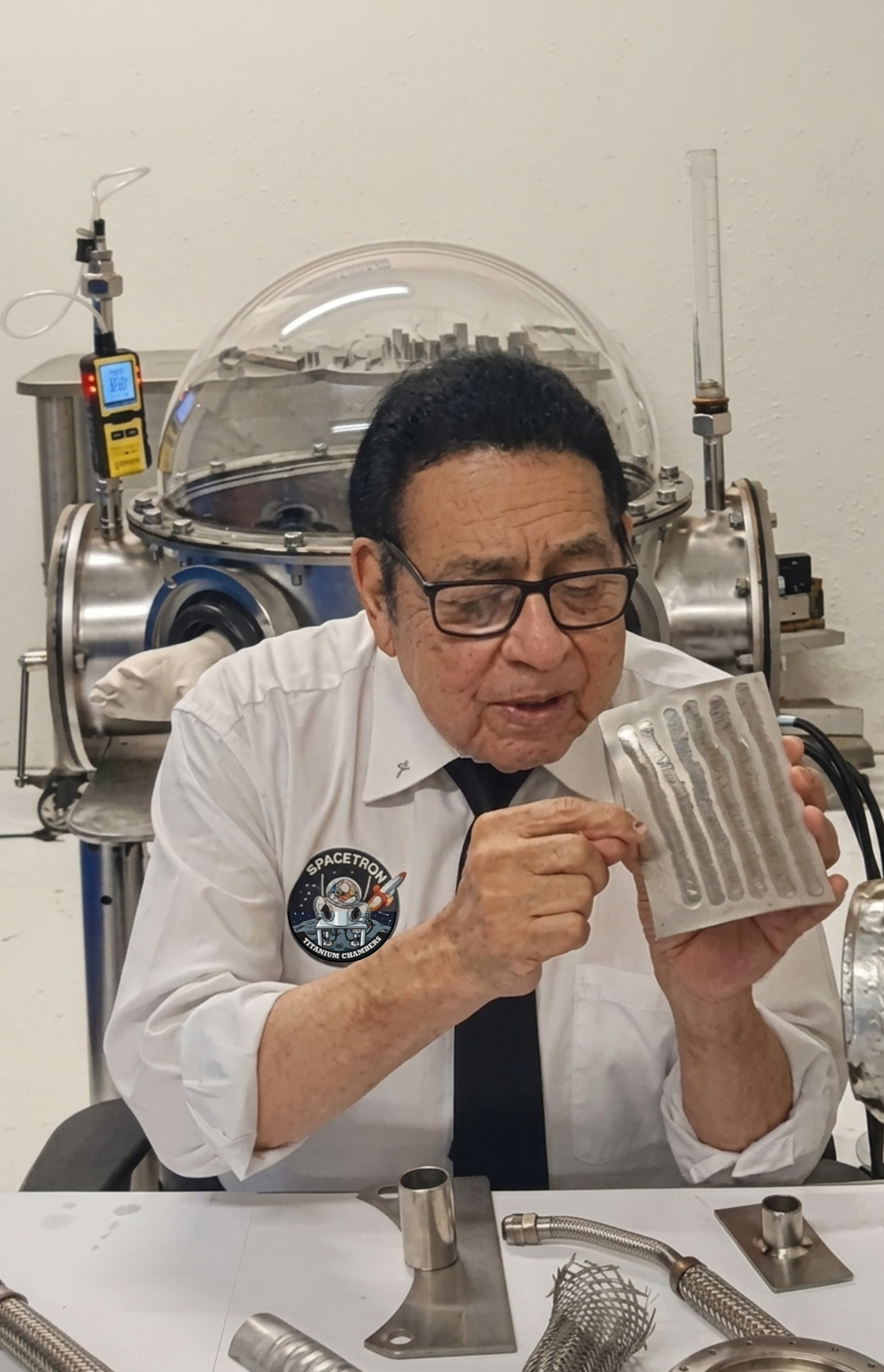
The 2008 Spacetron titanium strike plate
18 Years
A titanium strike plate welded inside a Spacetron closed-atmosphere chamber in 2008 remains perfectly silver today — zero discolouration, zero oxidation, zero corrosion after 18 years of ambient storage. This is not a controlled laboratory sample. It is a production weld made under total immersion conditions. The result is the proof of the process.
What 18 years of zero contamination proves
Total immersion GTAW eliminates oxidation at the source — not just during the weld but through the entire cooling cycle
The silver result is not temporary. A correctly welded titanium part in a zero-contamination atmosphere retains its metallurgical integrity indefinitely
Hardware longevity extends 3× or greater — components cooled in a Spacetron environment outlast ambient-welded equivalents by a significant margin
The colour scale is a permanent record. A silver weld cannot become contaminated retroactively. The colour you see is the truth of what happened during fabrication
This is reproducible on every TRON E-Series unit — the same result, every weld, in your production environment
Rick Montoya — SME Series, Episode 2
"I'm holding a titanium strike plate that was welded in a Spacetron chamber in 2008. Look at it — perfectly silver. Eighteen years later. That's not polish. That's what zero contamination looks like. Now look at the open-air weld next to it. That's what atmospheric exposure looks like. That's the difference between a part that passes and a part that doesn't."
— Rick Montoya, paraphrased from Open Air vs Total Immersion GTAW
—THE FABRICATION ENVIRONMENT COMPARED—
OPEN AIR
vs TOTAL IMMERSION.
The difference is not one of degree. It is one of kind. Total immersion GTAW does not do the same thing as open-air welding with better shielding — it eliminates the atmospheric variable entirely by replacing the air around the part with an inert environment before the first arc is struck.
VS
"The question is never whether total immersion is better. The question is whether you can afford the alternative — for your program, your qualification, and the people who depend on the hardware you build."

-THE ENVIRONMENT, COMMERCIALLY AVAILABLE-
THE SCIENCE
IS PROVEN.
THE SYSTEM
IS READY.
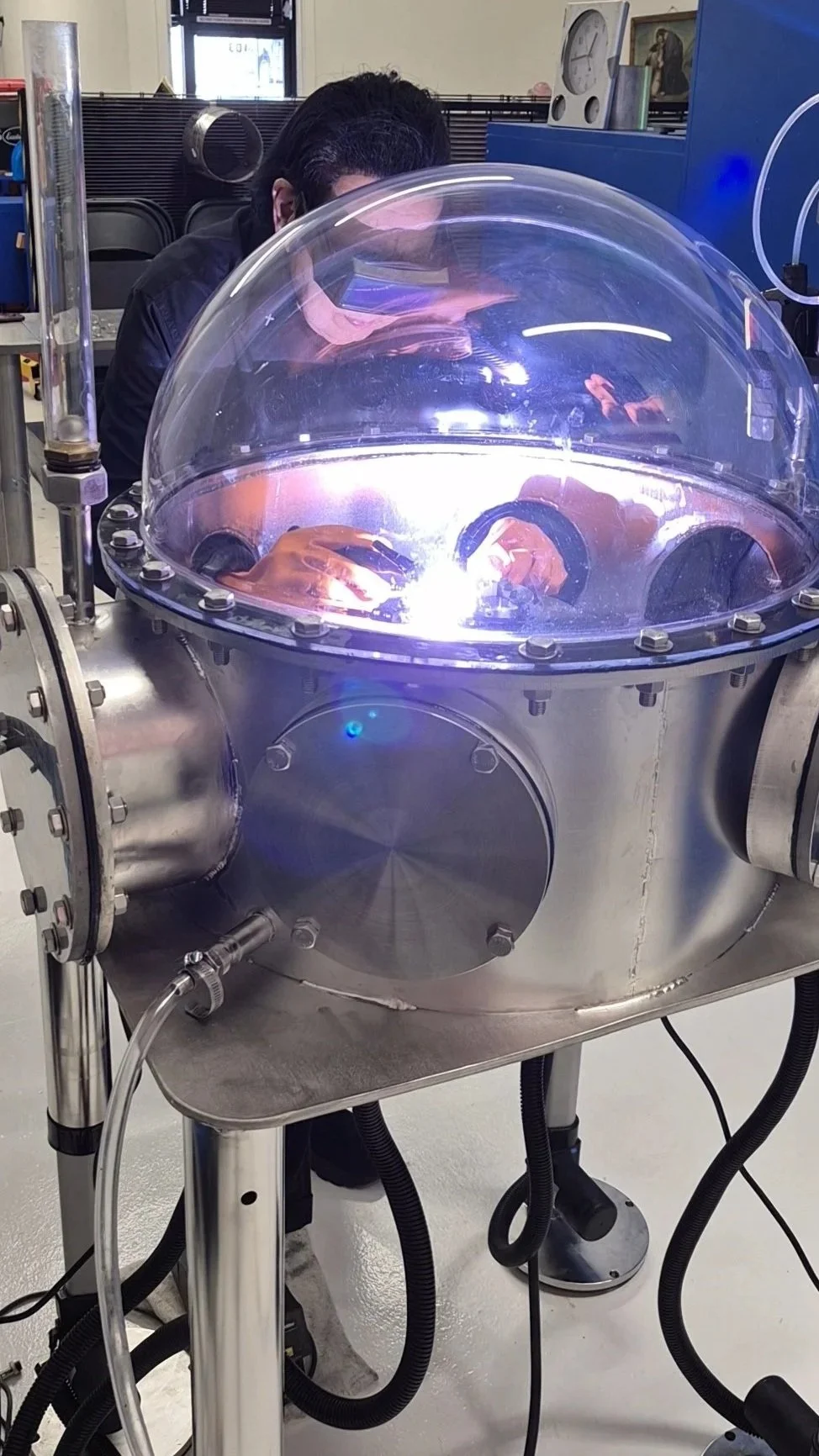
Every principle on this page — the color scale, the cooling phase, the 2008 strike plate — is the science behind the TRON E-Series Argon Weldstations. The TRON E-24 achieves a verified zero-oxygen environment in under five minutes, maintains 99.999% argon purity throughout the weld and cool-down cycle, and does so in a production-floor form factor that any qualified welder can operate.
Spacetron has been building and operating these environments since 1982. The TRON E-Series makes 48 years of flight-proven closed-atmosphere methodology commercially available — from the E-18 benchtop for precision medical and aerospace components to the E-120 for large-format cryogenic vessels and launch vehicle infrastructure.
-SEE THE SCIENCE IN ACTION-
RICK MONTOYA.
THE 2008
STRIKE PLATE.
ON CAMERA.
In Episode 2 of the SME Series — Open Air vs Total Immersion GTAW — Spacetron founder Rick Montoya holds the 2008 titanium strike plate in his hands and demonstrates the difference that total immersion makes. The silver result is not described. It is shown.
From hydrogen embrittlement to the silent failure of cold cracks, this episode covers the science of reactive metal contamination in the direct language of someone who has spent 48 years building systems to eliminate it.
THE ENVIRONMENT THAT MAKES IT POSSIBLE